Southern California Oracle #7 Nov 1967 Psychedelica
$150.00
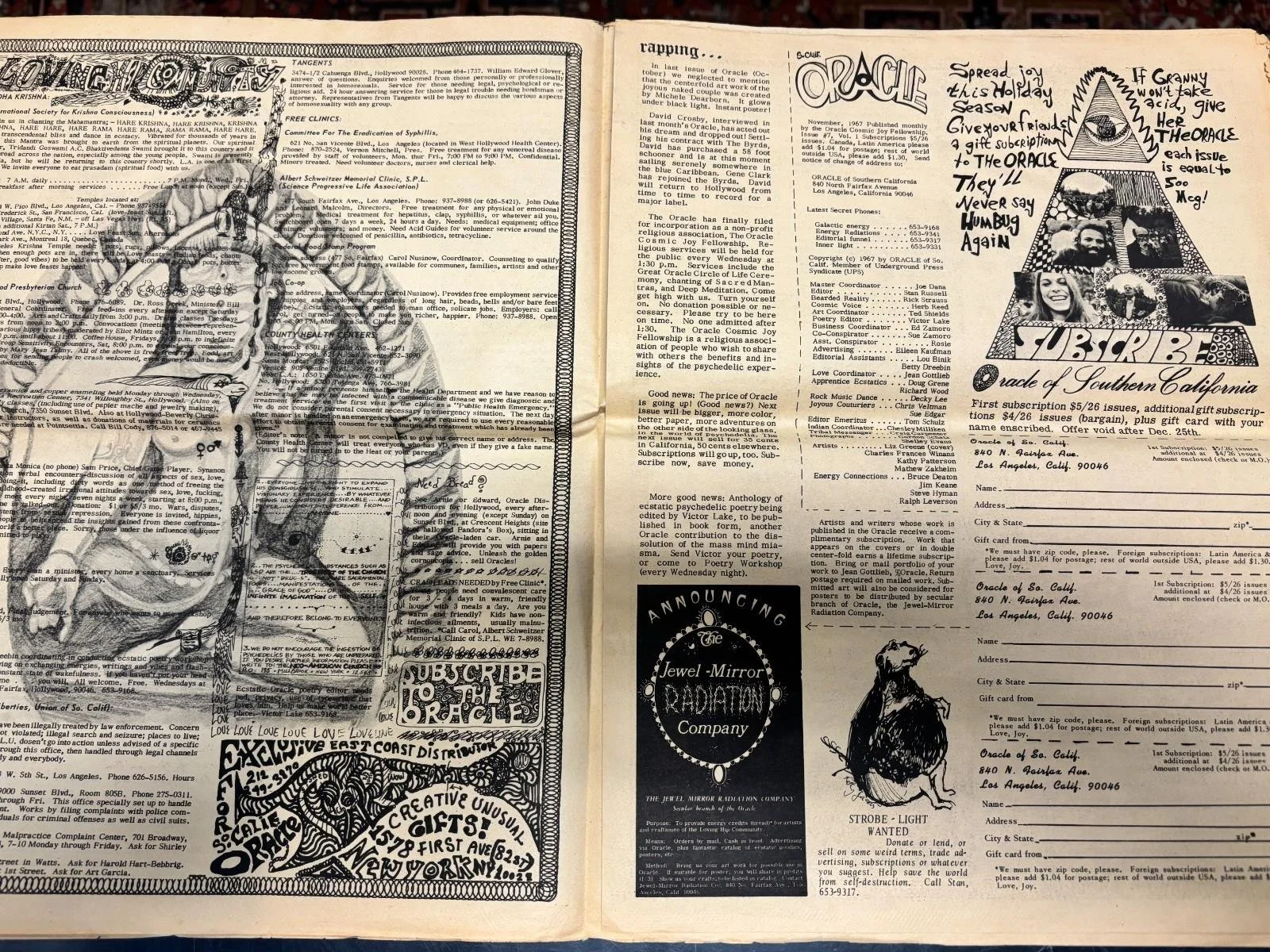
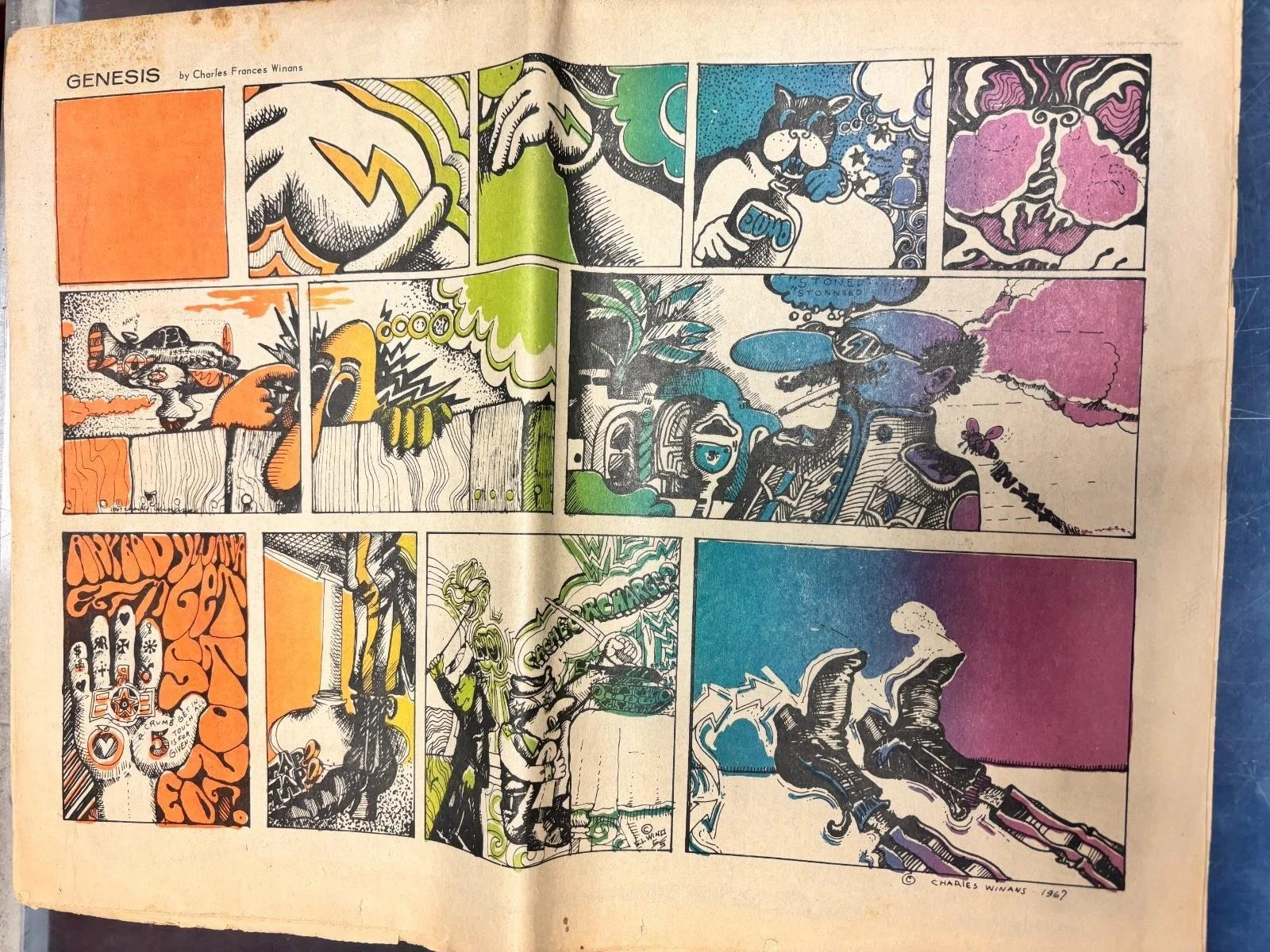
[Hippie Counterculture] The Southern California Oracle, the rare Hippie publication focusing on psychedelics, free love, mysticism, legal aid, and commune living. This newspaper archive comprises three original issues (No. 5, September 1967; No. 6, October 1967; No. 7, November 1967) published in Los Angeles during the apex of the West Coast counterculture. Each issue measures approximately 11 x 15 in. and is 24 or 32 pages in length. This visually electrifying archive contains full-color psychedelic artwork, interviews with key figures of the hippie movement, and exploratory prose and poetry that embodied the spiritual, sexual, and political revolution underway in 1960s America. Modeled on the San Francisco Oracle (1966–68), its Southern California counterpart quickly became a touchstone for the Los Angeles psychedelic community and a conduit for its evolving mystical ethos.
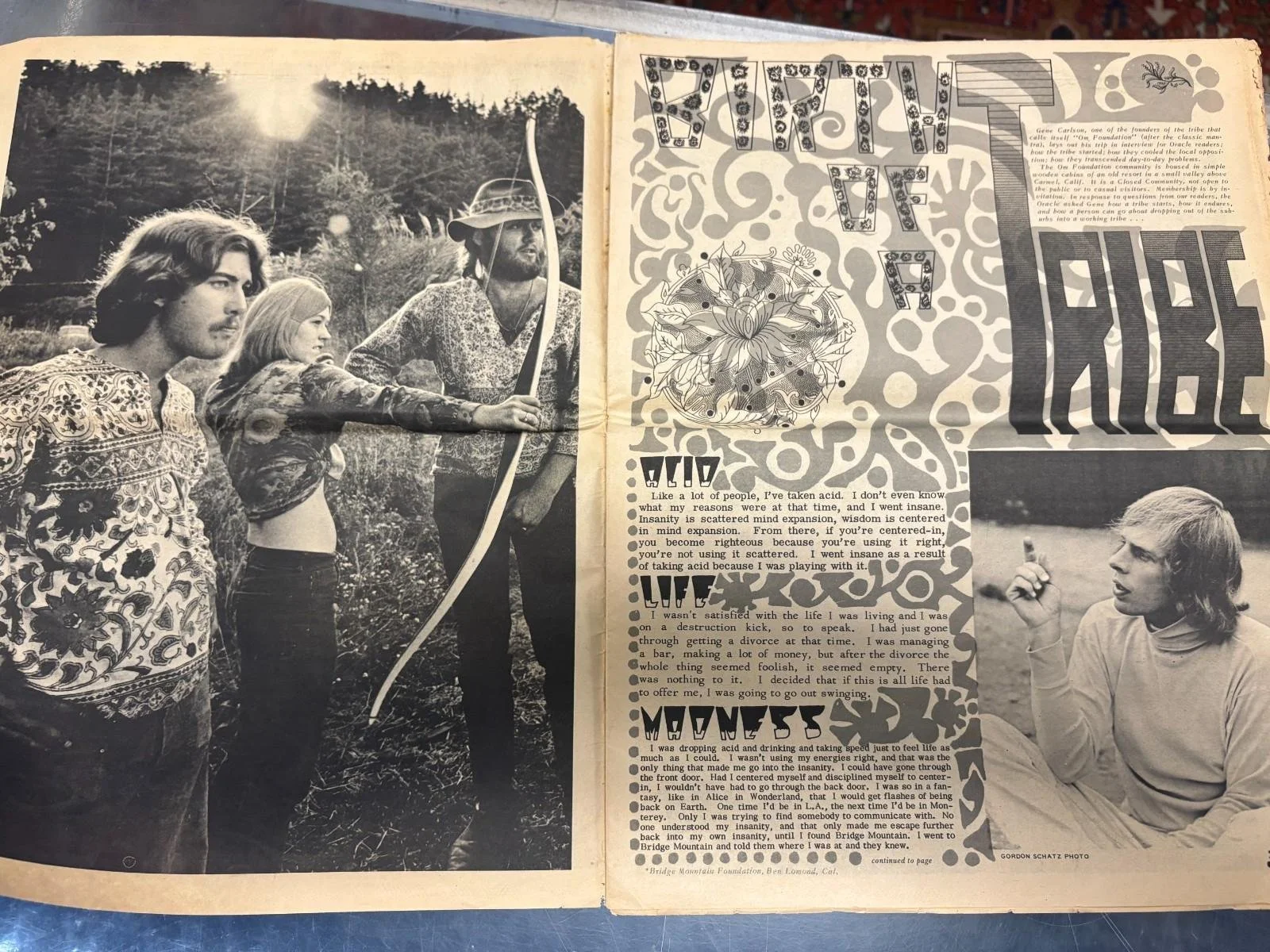
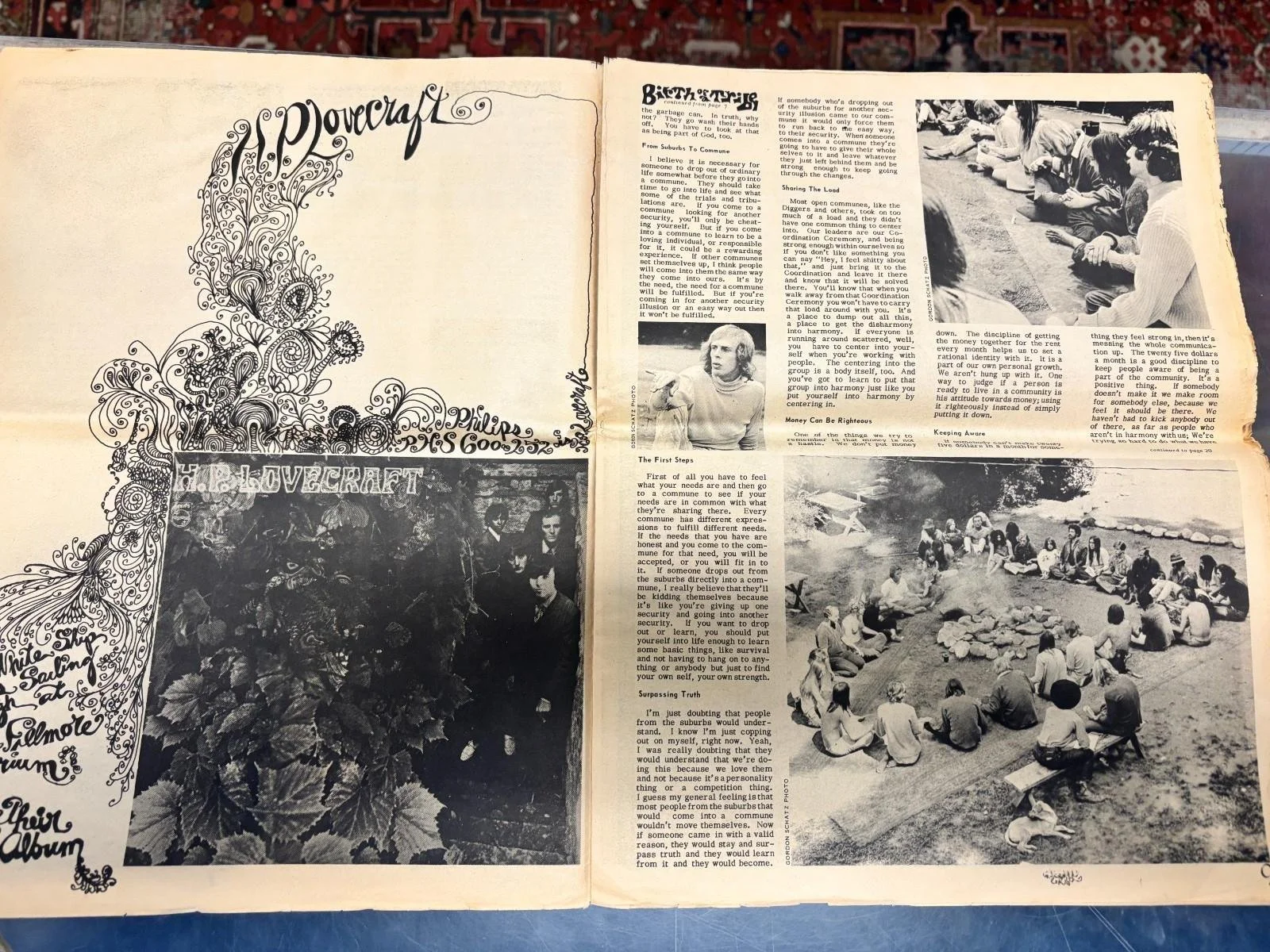
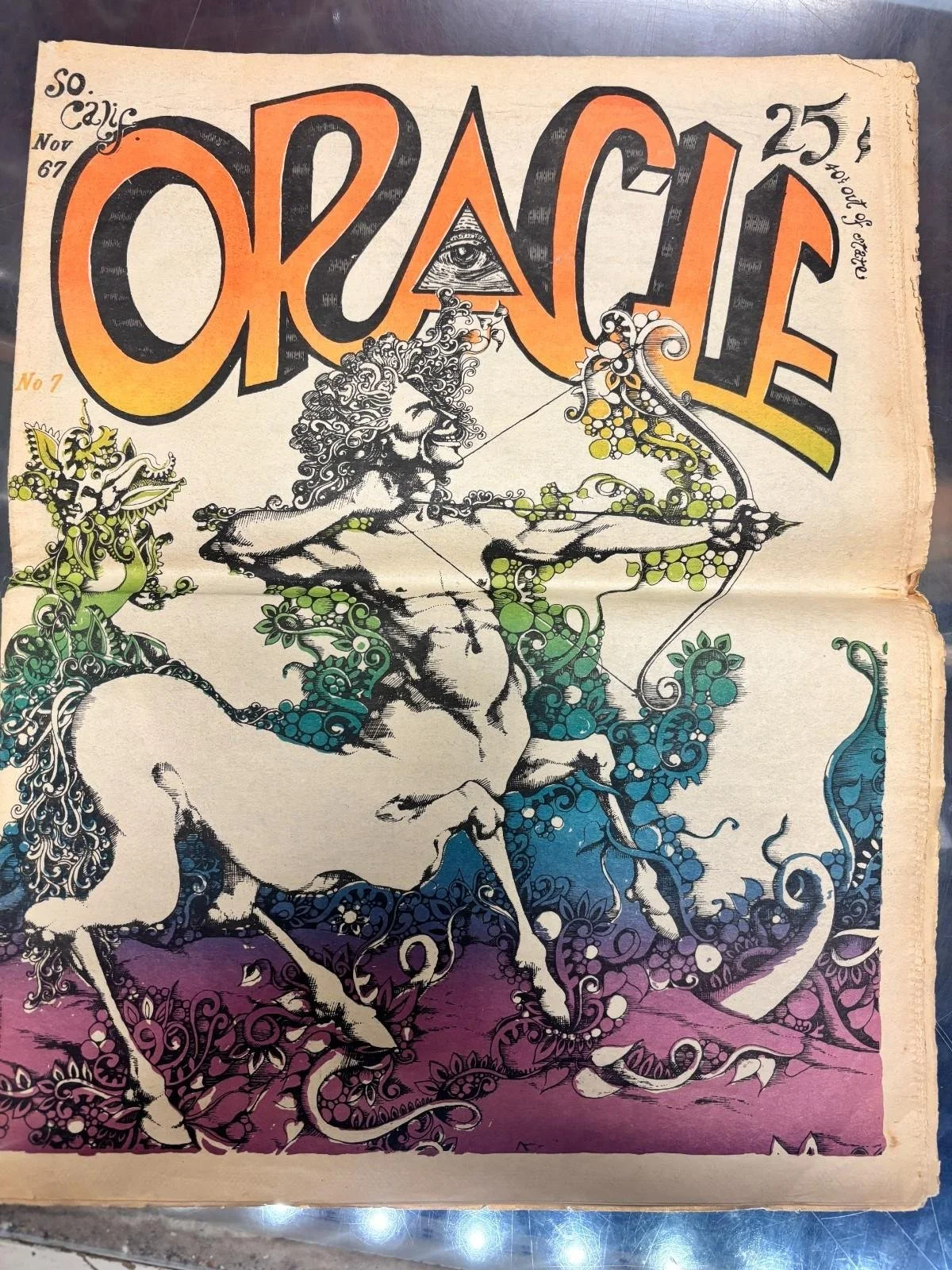
The covers of these three issues are themselves works of psychedelic art. Issue No. 7 (Nov. 1967) features a centaur archer rendered in swirling purples and lime greens, its hallucinogenic floral filigree weaving around the muscular hybrid form. Another cover shows a spectral, radiant goddess figure with piercing red eyes and an elaborate headdress—a visual invocation of the Divine Feminine, central to countercultural visions of pre-patriarchal harmony. The third issue, from October 1967, is awash with nude forest-dwelling figures, dancing freely in the woods—an Edenic hallucination of uninhibited communal life. Inside, richly inked spreads employ op art and kaleidoscopic symmetry, including a double-page mandala of distorted Beatles portraits accompanying “A Beatle Meets the Press,” a satirical meditation on media voyeurism and pop deification.Articles include “Birth of a Tribe,” an extended interview with group members of a rural hippie commune: “I don’t even know what my reasons were at that time, and I won’t invent any. It wasn’t a sensation–mind expansion, wisdom—it centered around acquaintances.” Another highlight is a prophetic centerfold by Timothy Leary titled “Tim Leary’s Prediction,” printed over a radiant orange-yellow gradient, where Leary proclaims Millbrook as “an advanced experimental station where people are working on the lifestyle of the future.” His language blends Eastern mysticism with early cybernetic futurism: “Psychedelic chemicals and psychedelic methods using electronics completely revolutionized man and his conception of himself.”
The Oracle was a core organ of the psychedelic spiritual movement, combining the visual aesthetics of San Francisco poster art with the esoteric philosophies of Aldous Huxley, Eastern religion, Native American cosmology, and radical politics. Emerging just after the Summer of Love, the Southern California edition offered an LA-specific lens on the broader countercultural tapestry, placing emphasis on natural mysticism, sexual liberation, and communal experiment. It functioned not just as an underground paper but as a sensorium—a ritual object meant to transmit altered consciousness through ink and image. Paper toned with light chipping to edges, especially along spines; centerfolds remain vibrant and complete. Vol. No. 6 is delicate and covers are separated. Overall good condition. An outstanding survival of one of the most artfully rendered and spiritually charged underground publications of the American counterculture, documenting the collision of psychedelia, utopian idealism, and anti-capitalist resistance through print.
The covers of these three issues are themselves works of psychedelic art. Issue No. 7 (Nov. 1967) features a centaur archer rendered in swirling purples and lime greens, its hallucinogenic floral filigree weaving around the muscular hybrid form. Another cover shows a spectral, radiant goddess figure with piercing red eyes and an elaborate headdress—a visual invocation of the Divine Feminine, central to countercultural visions of pre-patriarchal harmony. The third issue, from October 1967, is awash with nude forest-dwelling figures, dancing freely in the woods—an Edenic hallucination of uninhibited communal life. Inside, richly inked spreads employ op art and kaleidoscopic symmetry, including a double-page mandala of distorted Beatles portraits accompanying “A Beatle Meets the Press,” a satirical meditation on media voyeurism and pop deification.Articles include “Birth of a Tribe,” an extended interview with group members of a rural hippie commune: “I don’t even know what my reasons were at that time, and I won’t invent any. It wasn’t a sensation–mind expansion, wisdom—it centered around acquaintances.” Another highlight is a prophetic centerfold by Timothy Leary titled “Tim Leary’s Prediction,” printed over a radiant orange-yellow gradient, where Leary proclaims Millbrook as “an advanced experimental station where people are working on the lifestyle of the future.” His language blends Eastern mysticism with early cybernetic futurism: “Psychedelic chemicals and psychedelic methods using electronics completely revolutionized man and his conception of himself.”
The Oracle was a core organ of the psychedelic spiritual movement, combining the visual aesthetics of San Francisco poster art with the esoteric philosophies of Aldous Huxley, Eastern religion, Native American cosmology, and radical politics. Emerging just after the Summer of Love, the Southern California edition offered an LA-specific lens on the broader countercultural tapestry, placing emphasis on natural mysticism, sexual liberation, and communal experiment. It functioned not just as an underground paper but as a sensorium—a ritual object meant to transmit altered consciousness through ink and image. Paper toned with light chipping to edges, especially along spines; centerfolds remain vibrant and complete. Vol. No. 6 is delicate and covers are separated. Overall good condition. An outstanding survival of one of the most artfully rendered and spiritually charged underground publications of the American counterculture, documenting the collision of psychedelia, utopian idealism, and anti-capitalist resistance through print.
-Max Rambad
[Hippie Counterculture] The Southern California Oracle, the rare Hippie publication focusing on psychedelics, free love, mysticism, legal aid, and commune living. This newspaper archive comprises three original issues (No. 5, September 1967; No. 6, October 1967; No. 7, November 1967) published in Los Angeles during the apex of the West Coast counterculture. Each issue measures approximately 11 x 15 in. and is 24 or 32 pages in length. This visually electrifying archive contains full-color psychedelic artwork, interviews with key figures of the hippie movement, and exploratory prose and poetry that embodied the spiritual, sexual, and political revolution underway in 1960s America. Modeled on the San Francisco Oracle (1966–68), its Southern California counterpart quickly became a touchstone for the Los Angeles psychedelic community and a conduit for its evolving mystical ethos.
The covers of these three issues are themselves works of psychedelic art. Issue No. 7 (Nov. 1967) features a centaur archer rendered in swirling purples and lime greens, its hallucinogenic floral filigree weaving around the muscular hybrid form. Another cover shows a spectral, radiant goddess figure with piercing red eyes and an elaborate headdress—a visual invocation of the Divine Feminine, central to countercultural visions of pre-patriarchal harmony. The third issue, from October 1967, is awash with nude forest-dwelling figures, dancing freely in the woods—an Edenic hallucination of uninhibited communal life. Inside, richly inked spreads employ op art and kaleidoscopic symmetry, including a double-page mandala of distorted Beatles portraits accompanying “A Beatle Meets the Press,” a satirical meditation on media voyeurism and pop deification.Articles include “Birth of a Tribe,” an extended interview with group members of a rural hippie commune: “I don’t even know what my reasons were at that time, and I won’t invent any. It wasn’t a sensation–mind expansion, wisdom—it centered around acquaintances.” Another highlight is a prophetic centerfold by Timothy Leary titled “Tim Leary’s Prediction,” printed over a radiant orange-yellow gradient, where Leary proclaims Millbrook as “an advanced experimental station where people are working on the lifestyle of the future.” His language blends Eastern mysticism with early cybernetic futurism: “Psychedelic chemicals and psychedelic methods using electronics completely revolutionized man and his conception of himself.”
The Oracle was a core organ of the psychedelic spiritual movement, combining the visual aesthetics of San Francisco poster art with the esoteric philosophies of Aldous Huxley, Eastern religion, Native American cosmology, and radical politics. Emerging just after the Summer of Love, the Southern California edition offered an LA-specific lens on the broader countercultural tapestry, placing emphasis on natural mysticism, sexual liberation, and communal experiment. It functioned not just as an underground paper but as a sensorium—a ritual object meant to transmit altered consciousness through ink and image. Paper toned with light chipping to edges, especially along spines; centerfolds remain vibrant and complete. Vol. No. 6 is delicate and covers are separated. Overall good condition. An outstanding survival of one of the most artfully rendered and spiritually charged underground publications of the American counterculture, documenting the collision of psychedelia, utopian idealism, and anti-capitalist resistance through print.
The covers of these three issues are themselves works of psychedelic art. Issue No. 7 (Nov. 1967) features a centaur archer rendered in swirling purples and lime greens, its hallucinogenic floral filigree weaving around the muscular hybrid form. Another cover shows a spectral, radiant goddess figure with piercing red eyes and an elaborate headdress—a visual invocation of the Divine Feminine, central to countercultural visions of pre-patriarchal harmony. The third issue, from October 1967, is awash with nude forest-dwelling figures, dancing freely in the woods—an Edenic hallucination of uninhibited communal life. Inside, richly inked spreads employ op art and kaleidoscopic symmetry, including a double-page mandala of distorted Beatles portraits accompanying “A Beatle Meets the Press,” a satirical meditation on media voyeurism and pop deification.Articles include “Birth of a Tribe,” an extended interview with group members of a rural hippie commune: “I don’t even know what my reasons were at that time, and I won’t invent any. It wasn’t a sensation–mind expansion, wisdom—it centered around acquaintances.” Another highlight is a prophetic centerfold by Timothy Leary titled “Tim Leary’s Prediction,” printed over a radiant orange-yellow gradient, where Leary proclaims Millbrook as “an advanced experimental station where people are working on the lifestyle of the future.” His language blends Eastern mysticism with early cybernetic futurism: “Psychedelic chemicals and psychedelic methods using electronics completely revolutionized man and his conception of himself.”
The Oracle was a core organ of the psychedelic spiritual movement, combining the visual aesthetics of San Francisco poster art with the esoteric philosophies of Aldous Huxley, Eastern religion, Native American cosmology, and radical politics. Emerging just after the Summer of Love, the Southern California edition offered an LA-specific lens on the broader countercultural tapestry, placing emphasis on natural mysticism, sexual liberation, and communal experiment. It functioned not just as an underground paper but as a sensorium—a ritual object meant to transmit altered consciousness through ink and image. Paper toned with light chipping to edges, especially along spines; centerfolds remain vibrant and complete. Vol. No. 6 is delicate and covers are separated. Overall good condition. An outstanding survival of one of the most artfully rendered and spiritually charged underground publications of the American counterculture, documenting the collision of psychedelia, utopian idealism, and anti-capitalist resistance through print.
-Max Rambad